Trust and quality notes
- Last updated
- September 15, 2026
Automation changes the value of work before it changes our need to work. Tasks that can be stated clearly and checked quickly become easier to hand to software. The harder question is what happens to work that depends on judgment, imagination, coordination, and human contact. Nir Zicherman argues that these less verifiable forms of work will not merely survive AI. They may expand because AI can reduce the cost and complexity around them.[1]
That is a useful way to look past the immediate debate about job loss. It directs attention to the composition of jobs, the systems around creative work, and the human capabilities that become more important when routine execution is cheap.
The source's central argument
Zicherman starts with a pattern from earlier technological revolutions: work moves away from tasks that are easy to automate, while the resulting productivity creates room for other kinds of activity. He expects AI to continue that pattern. In his account, concrete and verifiable tasks face the clearest pressure because large language models are already good at completing work whose results can be checked.[1]
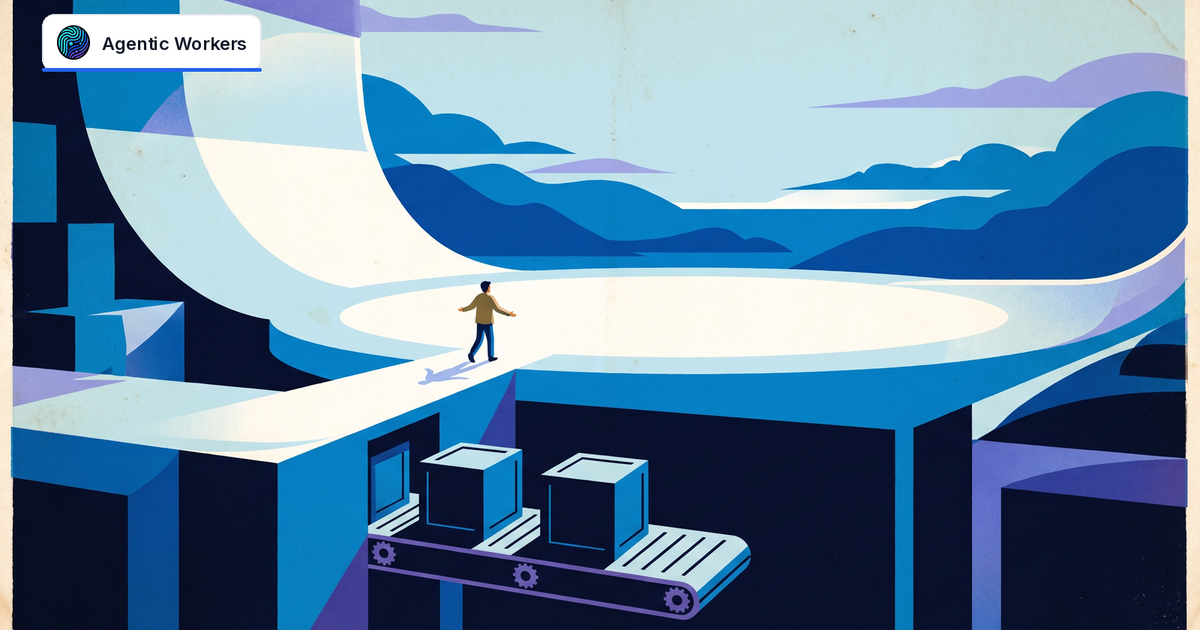
He contrasts those tasks with work involving ambiguity, open-endedness, and creativity. He sees structural limits in language models when they face those conditions. On that basis, he expects creative enterprises, organizational management, communication, human interaction, and systems-level oversight to become more important. The future he describes has fewer roles dominated by busy work and more roles built around capabilities he regards as distinctly human.[1]
This is not an argument that every creative or managerial job is protected. Nor does the source say that automation will arrive evenly. Its claim is narrower and more interesting: when machines make concrete execution abundant, the work that frames, guides, interprets, and connects that execution can grow.
Why scale matters as much as substitution
Most automation stories focus on replacement. Zicherman adds a second mechanism: scale. AI can perform support work around activities it cannot fully own. That may let people attempt projects that were previously too expensive, slow, or complicated.
His film example makes the distinction concrete. He argues that human actors and screenwriters remain central because storytelling and performance are creative enterprises. At the same time, financing, casting calls, and logistics can become much more streamlined. The point is not that a model makes a whole film by itself. The point is that reducing the administrative burden can expand what artists are able to make and how much creative risk they can afford to take.[1]
The implication is broader than film. A job is rarely one indivisible activity. It contains a mixture of planning, coordination, production, review, communication, and administration. Automation may remove or compress some pieces while increasing demand for others. Looking only at a job title can hide this rearrangement.
The human role moves toward framing and stewardship
If Zicherman is right, valuable work increasingly begins before a task is assigned and continues after an answer appears. Someone must decide what is worth doing, define the constraints, recognize when a result is technically correct but contextually wrong, and connect many automated actions into a coherent outcome.
His reference to systems-level roles is especially important. A large number of agents does not remove the need for responsibility. It creates more outputs, dependencies, and possible conflicts to oversee. People still need to determine priorities, settle ambiguity, communicate decisions, and notice when the system is pursuing the wrong objective.[1]
My interpretation is that this also changes what competence looks like. Speed at producing a discrete artifact may matter less when software can produce many versions quickly. The harder contribution may be choosing the direction, developing a point of view, making tradeoffs, and building trust among the people affected. Those are not mystical qualities. They are practices that can be strengthened through experience, feedback, and deliberate attention.
What is argument and what is interpretation
Zicherman explicitly predicts growth in creative, managerial, communicative, interpersonal, and systems-level work. My interpretation is that this creates a practical test for how to use AI now: separate the parts of a workflow that are concrete and verifiable from the parts that require contested judgment.
For the first category, automation can be given a clear target and a reliable check. For the second, AI may still help with options or preparation, but a person should retain responsibility for direction and evaluation. This is not a claim that AI can never improve at ambiguous work. The source does not prove a permanent technical boundary. It offers a labor-market thesis based on present structural limitations and on the recurring way technology changes the mix of work.
A second interpretation is that leaders should measure capacity created, not only time removed. If administrative work becomes cheaper, the benefit might appear as more experiments, more attention to collaborators, or projects that were previously out of reach. A narrow efficiency metric can miss that expansion.
How to apply the idea without overreaching
Start with a real workflow and list its parts. Mark each part by how clearly success can be specified and verified. Routine transformations, retrieval, formatting, scheduling, and first-pass checks may be strong candidates for automation. Decisions involving taste, conflicting goals, sensitive relationships, or unclear consequences require closer human control.
Then ask what the saved effort should make possible. If the answer is only more output, the workflow may create volume without value. Zicherman's thesis points toward a better question: what human capability can now operate at a scale that was previously impractical? That might be more thoughtful review, more direct conversation, or more room to explore a creative direction. These are interpretations of his framework, not promises made in the source.
Finally, keep the transition realistic. Zicherman says the shift will take several decades.[1] Existing roles, institutions, and expectations will not reorganize overnight. People will need time to learn how to supervise automated systems and how to value work that was previously crowded out by busy work.
Humans do not win simply because machines fail. Automation changes where human attention can be used. The opportunity is to move that attention toward ambiguity, care, coordination, and creation while building reliable systems around it.
If you want to put that division of labor into practice, Agentic Workers can help you build a workflow that keeps human judgment where it matters.