Trust and quality notes
- Last updated
- September 6, 2026
A job title can answer a social question before a real conversation begins. It suggests status, skills, income, and affiliation in a few words. That convenience also makes it easy to let paid work carry more of your identity than it can safely hold.
Simone Stolzoff argues that automation will weaken the job title as a placeholder for who someone is. In his original essay [1], he expects personal missions, hobbies, and fandoms to become stronger anchors of identity. Human work will remain necessary in his account, but the label attached to that work will say less about the person doing it.
Work became a compressed identity
Stolzoff begins with a familiar habit: treating how someone makes money as shorthand for who they are. He says work has eclipsed faith and friends as a source of meaning for many people in recent decades, especially in the United States. Jobs now supply not only income but also community, purpose, and a socially legible identity.
This arrangement can feel efficient. A prestigious employer in a social bio signals achievement without requiring explanation. A title gives strangers a quick category. But it also concentrates several human needs in an institution that was not designed to hold all of them.
Stolzoff’s “Twitter Bio Test” captures the pattern. In the 2010s, he writes, the most important line in many bios was the company tag. Association with a company such as Google or Stripe conveyed digital clout. The person’s employer became the leading fact about the person.
My interpretation is that automation exposes how fragile this compression has always been. If roles change faster, titles become broader, or machines perform more of the tasks once associated with a profession, the label loses explanatory power. People then have to describe themselves with more substance.
The title loses detail before work disappears
Stolzoff does not argue that human work ends. He explicitly says it will continue to be necessary. His claim is narrower: the job title will stop functioning as an adequate identity marker.
He sees an early sign in frontier AI labs where engineers use a broad label such as “member of the technical staff” rather than a hierarchy of conventional titles. The source does not establish that every industry will copy this naming practice. It uses the example to show how a prestigious role can become less specific even while the work remains important.
For a person entering an AI-shaped workplace, this distinction matters. A changing title is not the same as a disappearing self. The tasks attached to a role may be redistributed among people and tools. The social meaning once attached to the label may fade. Neither change settles what the individual values or contributes.
My reading is that this can be both unsettling and clarifying. It is unsettling because familiar signals become less reliable. It is clarifying because a person can no longer outsource the explanation of who they are to an employer’s brand.
Attention shifts toward chosen commitments
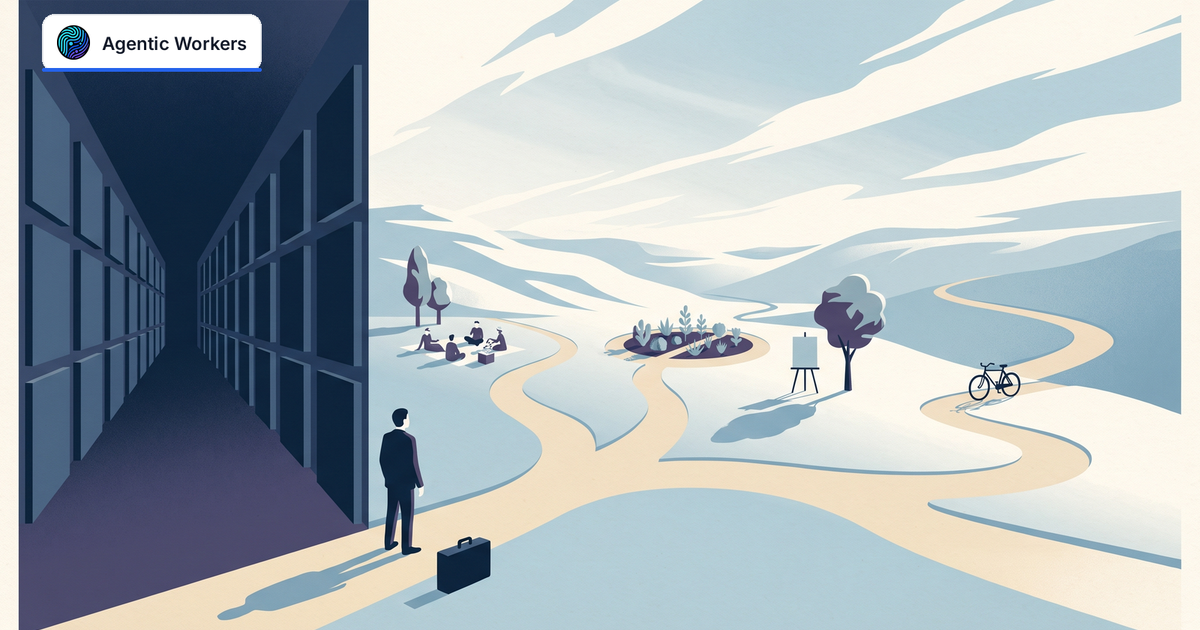
Stolzoff believes personal mission statements, hobbies, and fandoms will become new anchors of identity. These are things people do because they want to, not because someone pays them. In a world where attention is scarcer than labor, he argues, what you believe and love will matter more than your title.
The phrase “personal mission statement” can sound formal, but the idea need not be. It may simply mean being able to say what you care about and where you choose to spend finite attention. Hobbies and fandoms matter because they reveal voluntary commitments. They show a person in excess of economic function.
This is the source’s argument, not a promise that automation will automatically create a richer civic or personal life. Stolzoff does not claim that everyone will receive more free time or equal freedom to pursue interests. His focus is on identity and social signaling. The title weakens, so other commitments carry more weight.
My interpretation is that those commitments need to be cultivated before they are needed. If work currently supplies all your community, challenge, and recognition, it may be difficult to build alternatives during a sudden transition. A hobby practiced badly, a local group attended consistently, or a subject studied without a career plan can create a wider base for identity.
A broader self changes how you use automation
Stolzoff’s thesis has a practical implication for adopting AI at work. If the goal is only to protect a title, every capable tool can feel like a threat to the self. If identity rests on several foundations, it becomes easier to ask a more useful question: which tasks should remain mine because they express judgment or care, and which tasks can be delegated without reducing who I am?
That question is my application of his essay. The source does not offer a workflow for task selection. It does, however, separate necessary human work from the title used to describe it. That separation allows a person to examine tasks without treating every change as an existential verdict.
A broader identity can also improve collaboration. Someone who knows what they value can state preferences more clearly, choose projects more deliberately, and recognize when an employer’s incentives conflict with a personal mission. Automation does not produce that clarity. It can make the absence of it harder to ignore.
Introduce yourself without borrowing a logo
Stolzoff’s view of humanity after automation is modest but consequential. People continue working, yet work stops serving as such a powerful shortcut for identity. The social question “What do you do?” becomes less capable of carrying the answer to “Who are you?”
A useful exercise is to write a short description of yourself without mentioning an employer, title, or professional credential. What beliefs, interests, communities, and chosen projects remain? This exercise is my interpretation of the Twitter Bio Test, not an instruction from Stolzoff. Its purpose is to reveal whether your identity has enough independent material.
The answer does not have to be impressive. In fact, replacing corporate status with a performance of personal branding would preserve the same problem in a different form. The deeper shift is from borrowed prestige to lived commitments.
Automation may change what society needs people to do for pay. Stolzoff’s argument is that it can also change what people use to recognize one another. In that future, what you repeatedly choose to notice, support, practice, and love becomes more informative than the words beneath your name on an org chart.
If you want to decide which parts of your work should be delegated without letting work define your whole life, start with one process at Agentic Workers.