Trust and quality notes
- Last updated
- October 6, 2026
A fast system can still produce slow decisions if nobody shares the same picture of reality. AI agents may act in seconds while teams meet weekly, budgets change quarterly, and strategy is reconsidered once a year. Tom Critchlow argues that the central challenge after automation is not merely faster thinking. It is creating a common rhythm for humans and agents.[1]
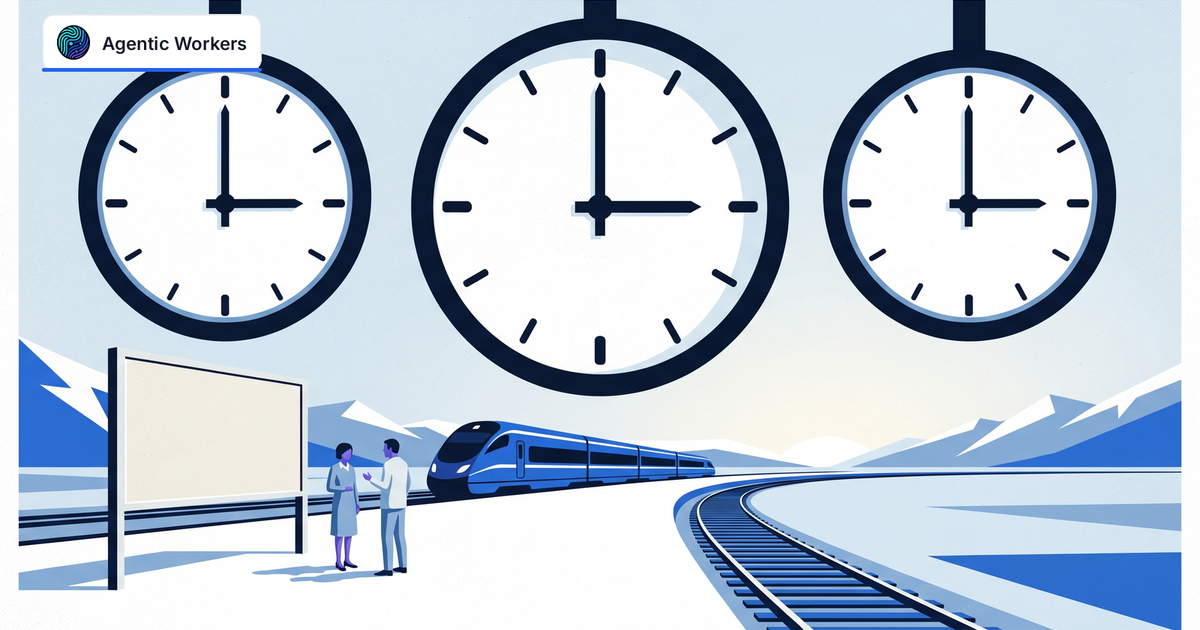
His metaphor is a clock. Industrial society needed standardized time to coordinate faster railways. Organizations using AI now need what he calls standard status: a continuously updated record of goals, decisions, permissions, and constraints.[1]
The source's central argument
Critchlow begins with the period before the 1800s, when places did not share a universally agreed time. Faster trains made local differences costly. Stations had to synchronize, and standard time and time zones emerged from that coordination need.[1]
He sees a similar mismatch inside modern organizations. Agents operate rapidly, but human processes retain very different cycles. Meetings, financial planning, and leadership strategy each use a different snapshot of reality. As the delay between those snapshots grows, people and systems may act on incompatible assumptions.
Standard status is Critchlow's proposed coordination mechanism. It would keep a shared account of what the organization is trying to do, what has been decided, what is permitted, and what constraints apply. Humans and agents would use the same changing record rather than relying on scattered updates.[1]
But he immediately complicates the idea. Synchronization is not the same as alignment. Meetings and planning rituals do more than transfer facts. They help people feel heard, maintain motivation, interpret ambiguity, and renew commitment. A perfect status record might tell everyone what is current without telling them what the situation means or whether they still agree.
Why speed creates a context problem
Automation increases the number of actions a system can take between human conversations. That makes stale context more consequential. An agent following last week's goal can do more wrong work before the next meeting notices. A person making a decision from last quarter's assumptions can conflict with a system that has already absorbed newer information.
The issue is not simply missing documentation. It is temporal consistency. Goals, permissions, and constraints change. If those changes do not propagate together, different parts of the organization inhabit what Critchlow calls different presents.[1]
His clock metaphor helps because a clock does not make a train move. It allows many participants to coordinate movement. In the same way, a shared status does not replace judgment or execution. It gives humans and software a reference point for deciding what is relevant now.
What belongs in standard status
Critchlow names four categories: goals, decisions, permissions, and constraints.[1] Each addresses a different failure.
Goals tell the system what outcome currently matters. Decisions prevent an old debate from reopening without reason. Permissions define what a person or agent may do without further approval. Constraints preserve limits that speed must not erase.
My interpretation is that a useful status must also show provenance and timing. Readers should be able to see who changed a consequential instruction, when it changed, and which work depends on it. Critchlow does not specify these fields, so they should be treated as a design extension rather than part of his stated proposal.
A second interpretation is that status should be small enough to govern action. A continuously updated archive can become another form of noise. The value lies in a trusted current record, not in accumulating every message. Supporting evidence may sit behind it, but the active goals and boundaries must remain legible.
Coordination cannot carry the full weight of alignment
Critchlow's strongest caution is that work rituals are partly social. A weekly meeting may look inefficient if every factual update is already available. Yet the meeting may allow disagreement to surface, give a quiet colleague room to speak, or help a team absorb a difficult change.
Replacing that ritual with a generated summary could preserve information while losing participation. An agent can record a decision, but the record alone cannot guarantee that people understand, accept, or feel responsible for it. This is why Critchlow closes by distinguishing knowing the time from knowing what the moment requires.[1]
Humanity after automation, in his account, retains a role in interpretation. People do not gather only because databases are incomplete. They gather to negotiate meaning, renew relationships, and judge ambiguous circumstances. Better coordination may free those conversations from routine updates, but it does not make the conversations unnecessary.
What is argument and what is interpretation
Critchlow explicitly argues that AI has accelerated thinking without synchronizing organizational workflows. He proposes standard status as a shared, continuously updated mechanism and warns that it cannot by itself solve human alignment.[1]
My practical interpretation is that teams should separate status rituals from alignment rituals. If a meeting exists mainly to collect updates, a shared record may replace much of it. If it exists to resolve conflict, build commitment, or interpret uncertainty, it still needs deliberate human participation. Many meetings do both, so the sensible move may be to automate the update portion and protect the discussion portion.
Another interpretation is that permissions deserve equal weight with goals. Rapid systems often emphasize what an agent should accomplish while leaving the limits implicit. A live record of authority makes speed safer because the system knows not only the destination but also when it must stop and ask.
These are applications of Critchlow's idea, not claims that his article provides a finished operating model. The source offers a framing and a warning, not a product specification.
Building a better clock in practice
Start by identifying decisions that frequently become stale. Look for work repeated because one group did not know another had changed direction. Note where an agent or person acted from an outdated permission or constraint.
Create one current record for a narrow workflow. Include the active goal, recent binding decisions, who may take which actions, and the limits that require escalation. Give each consequential change an owner and time. Then make that record available at the point where work begins, rather than asking people to remember to search for it.
Review what remains unresolved. A status should not manufacture certainty. If leaders disagree or a constraint is unclear, the record should expose that ambiguity and route it to a human conversation.
Finally, examine existing meetings before removing them. Ask what social or interpretive function each ritual serves. Keep the parts that help people align and discard the parts that merely recite information already available. The objective is not fewer human interactions at any cost. It is to spend human time on what a shared clock cannot decide.
Critchlow's thesis reframes advantage after automation. The best model may produce faster answers, but an organization that cannot maintain a common present will struggle to use them coherently. Speed becomes useful when goals, authority, and judgment move together.
If your team needs a shared rhythm for human and automated work, Agentic Workers can help you design a workflow with current goals, clear permissions, and deliberate review.