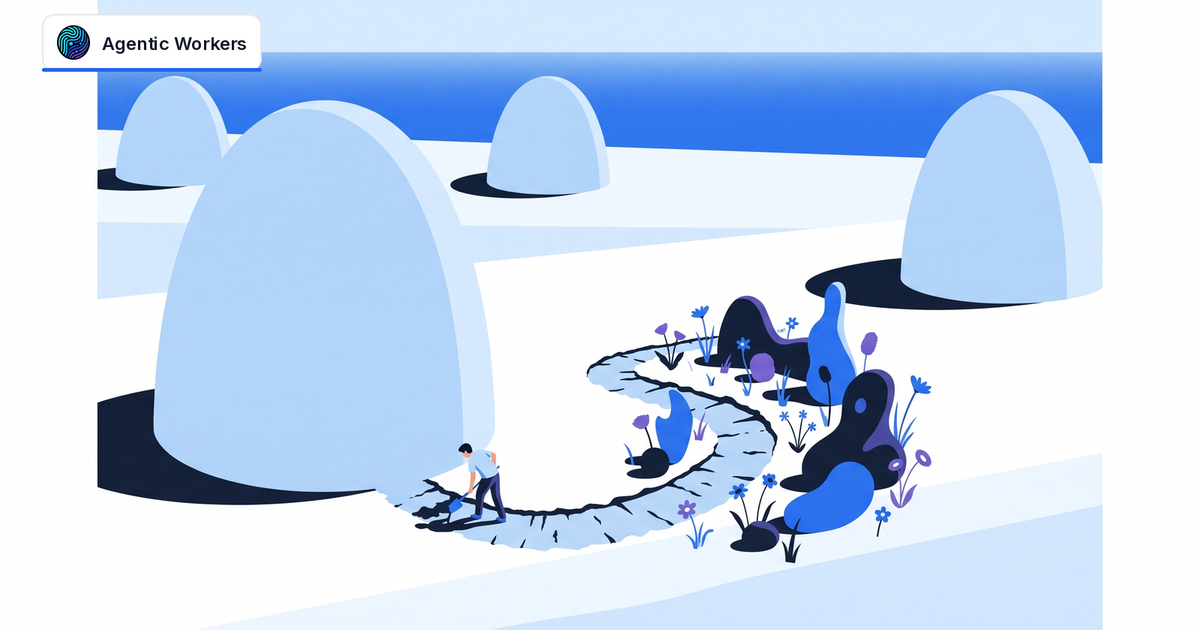
Trust and quality notes
- Last updated
- October 21, 2026
Efficiency can make work smoother while making the result more ordinary. When the same tools help everyone produce polished outputs, the details that once looked awkward or unnecessary may become the strongest evidence that a person is present.
Bethany Crystal argues that weirdness will be a human advantage after automation. In her original essay [1], she connects AI not only with productivity but with a return to playful, experimental work. Her case is personal: the technology that lets her run a company solo also gives her room to build peculiar projects that express her interests rather than a standardized professional identity.
Optimization taught people to become normal
Crystal begins with a childhood nickname, “Wheely Bag Girl.” She was the only student with a rolling backpack and spent time on unusual private pursuits, including reorganizing a business card collection and adding rubber bands to a large ball. She describes the early internet as a place where strangeness and peculiarity felt normal.
Then, in her telling, the web matured and optimized itself. It asked people to optimize themselves too. Crystal says she listened and became normal. This is not a general history of the internet supported by multiple sources. It is the autobiographical frame of her argument: systems built for scale can reward familiar formats and legible behavior.
My interpretation is that optimization creates a subtle selection pressure. When people can see what performs, converts, or resembles successful work, they may narrow their experiments before anyone explicitly asks them to. The result can be competent and recognizable but less personal.
Automation might appear likely to intensify that pattern. A model trained on existing material can quickly produce something that looks like the category. Crystal’s surprise is that her own experience moved in the other direction.
AI can make small experiments affordable
Crystal says she now runs alone a company that would have required five people before AI. That is her reported experience, not a benchmark for what every person or business should expect. The more revealing part of her essay is what she does with the resulting capacity.
She builds bingo card apps for friends, makes highly personalized playlists for clients, and relaunched her blog as a choose-your-own-adventure experience. She notes that the blog project does not make money. Its value is that she had wanted to make it for years.
These examples show how lower production barriers can serve idiosyncratic intent. A project does not need a large market or a formal team to justify its existence. It can be useful to a few friends, tailored to one client, or satisfying to its maker.
The source’s claim is not that every automated project is creative. Crystal says AI has reintroduced a playful and experimental way of working for her. My interpretation is that cheap trials expand the space in which personal taste can act. The tool supplies leverage, but the strange direction still comes from the person.
Project-based work can reveal what you care about
Crystal sees the conventional workday becoming decoupled into a series of project-based interests focused on craft and passion. That is a forward-looking claim in the source, not an established outcome. It captures her hope that automation can loosen the link between a fixed schedule and a narrow professional role.
For a reader, the useful question is smaller than redesigning an entire career. What project have you postponed because assembling the first version required too much time, coordination, or technical knowledge? AI may help lower that barrier. The important part is choosing a project that carries your curiosity rather than copying the most visible use case.
This does not mean every eccentric impulse deserves automation or public release. Judgment still matters. Some projects involve privacy, safety, or consequences that demand expertise and review. Crystal’s examples are playful and bounded. Their weirdness is not recklessness.
My reading is that a small personal project can function as a test of agency. Instead of asking a tool what you should make, begin with the thing you already find funny, beautiful, obsessive, or oddly useful. Then use the tool to explore it.
Weirdness is not a style preset
Once weirdness becomes an advantage, it is tempting to manufacture it. A brand can add quirky language, random visuals, or deliberate rough edges and call the result human. That would miss Crystal’s point.
Her weirdness has a history. It comes from specific interests, memories, and social relationships. A bingo app for friends is particular because it reflects a shared context. A personalized playlist matters because it is made for an actual client. The form follows the relationship and the maker’s taste.
This distinction matters in AI-assisted work. A prompt can request something “weird,” but surface novelty is not the same as lived peculiarity. The human advantage Crystal describes is rooted in wanting something unusual enough to make it, even when it does not optimize revenue or status.
My interpretation is that the best safeguard against generic output is not a more elaborate instruction alone. It is a richer input from the person: references they genuinely love, constraints drawn from the situation, private jokes, unresolved questions, and standards that cannot be inferred from a generic request.
Preserve the reason nobody else would make it
Crystal’s picture of humanity after automation is playful rather than defensive. People remain human by following extreme niches and quirky habits, especially after tools make conventional production easier. Automation handles enough of the burden to let a solo person attempt work that once required a team.
There is still a tension in this picture. The same systems that enable experimentation can also produce oceans of polished sameness. Crystal resolves that tension through intention. AI does not supply the reason to make the project. It makes the person’s unusual reason easier to express.
A practical way to apply her thesis is to review a draft or product and ask what in it could only have come from your circumstances. If every choice could be replaced with the most likely choice, the work may be polished but hollow. Add the detail that reflects a real relationship, obsession, or point of view. This is my application of Crystal’s essay, not a formula she gives.
After automation, professional competence may become easier to simulate. Genuine peculiarity will still be costly in a different way. It asks someone to risk looking odd, spend attention without guaranteed return, and make a choice that the average output would never predict.
If you want to remove routine work while protecting room for the projects only you would choose, start with one process at Agentic Workers.